
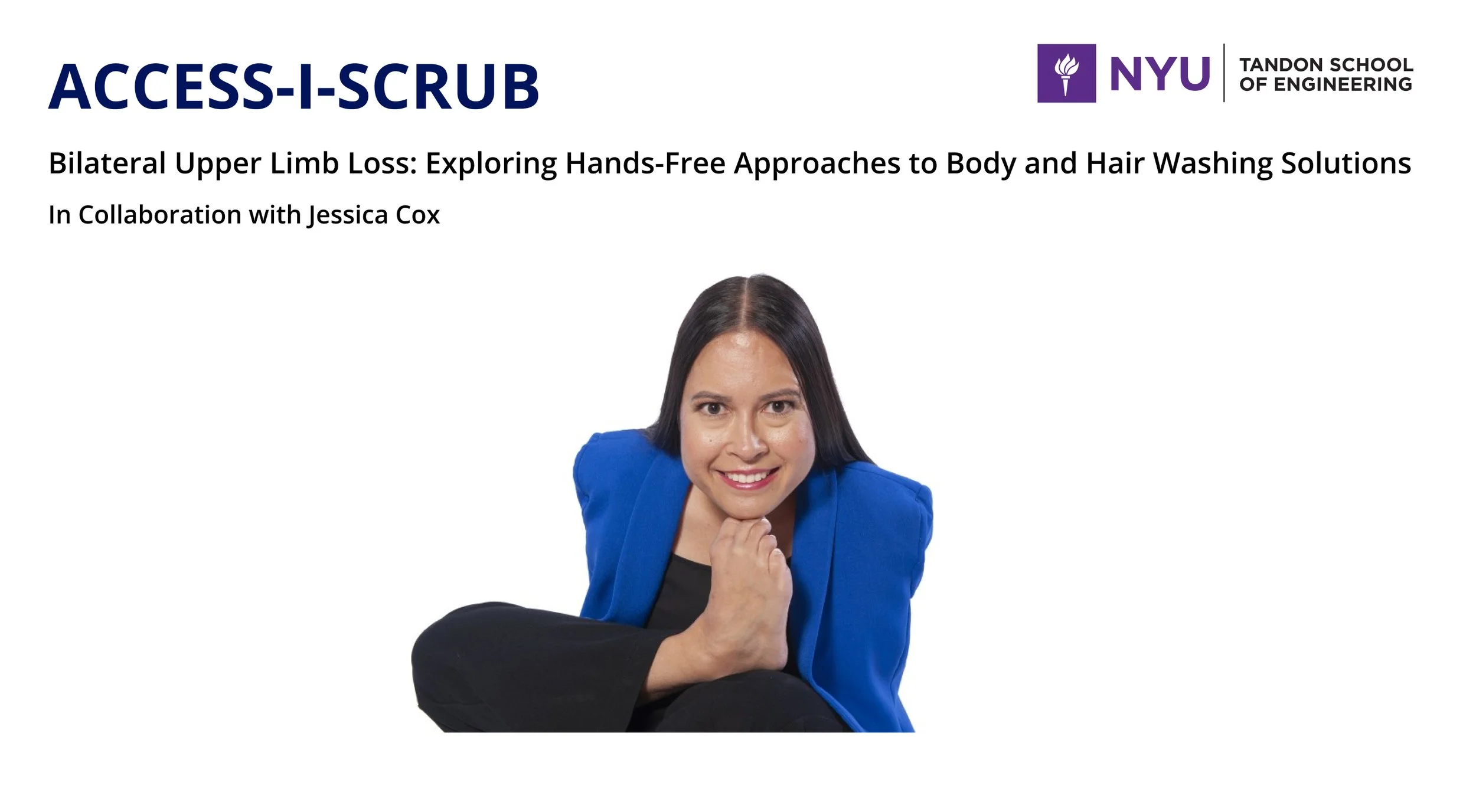
ACCESS-I-SCRUB
Bilateral Upper Extremity Limb Loss: Exploring Hands-Free Approaches to Body and Hair Washing Solutions
Master’s thesis in collaboration with Jessica Cox
OVERVIEW
For individuals with bilateral upper limb loss, everyday hygiene tasks can require complex workarounds. ACCESS-I-SCRUB was my master’s thesis project, created specifically to address these challenges through hands-free approaches to body and hair washing. Conducted in close collaboration with Jessica Cox, the system was designed around her individual routines and preferences. The project received IRB approval and applied user-centered design, accessibility principles, and iterative prototyping to support independent daily care in physically demanding or constrained environments.
ROLE
UX & Physical Product Designer
UX Strategy
User Research
Interaction & Physical Product Design
Prototyping & Usability Testing
Accessibility & Ergonomics
Stakeholder Collaboration & Co-Creation
Iterative Design & Documentation
TOOLS
Fusion 360, 3D Printing, Figma, Adobe Creative Suite
About the Project
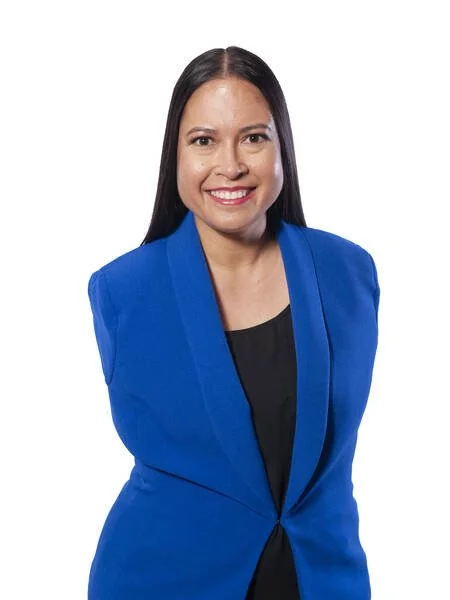
Millions of everyday products exist, yet universal design often serves the majority, not everyone. For my thesis, I partnered with Jessica Cox, motivational speaker and Guinness World Record holder, to explore how we could make everyday tasks like showering more accessible and empowering for individuals with bilateral upper extremity limb loss. Millions of everyday products exist, yet universal design often serves the majority, not everyone.
ACCESS-I-SCRUB is a showering system that enables hair scrubbing and body washing without upper limb use. Through interviews, research, prototyping, and testing, I developed custom-built solutions, combining existing products with 3D-printed components to meet real-world needs.
This project demonstrates the power of inclusive design, raising awareness and pushing the boundaries of assistive technology to make essential daily routines accessible for all.
Bilateral Upper Extremity Limb Loss
The goal of this study was to understand the challenges and experiences of people with bilateral upper limb loss when using technology. For this project, bilateral upper limb loss refers to the loss or absence of any part of the arm, from the shoulder to the fingers.
I defined technology broadly: any product, design, or assistive modification whether completely new or an adaptation of an existing product that helps make daily tasks easier and more usable for people with upper limb loss.
Discovery and Research Phase
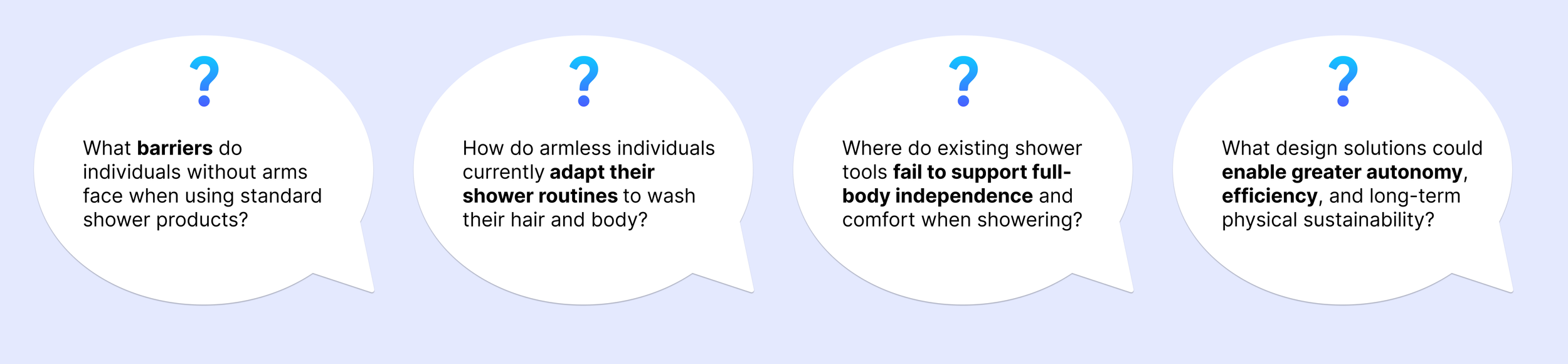
I framed questions to uncover barriers, adaptations, and design opportunities in daily shower routines, focusing on improving independence and long-term comfort.

2026 US Statistics
The Challenge
There is currently no off-the-shelf product available to assist Jessica with showering, making daily hygiene tasks difficult and inefficient. This project explored existing products to assess adaptability and also developed custom solutions to meet the unique needs of someone with bilateral upper-limb loss.
To ensure the design addressed Jessica’s real needs, I used participatory design, collaborating with her through every step and decision to fully understand her pain points, habits, and goals. I also applied the Occupational Therapy (OT) task analysis framework, examining the dynamic relationship between Jessica, her showering tasks, and the context in which she performs them.
Research Process
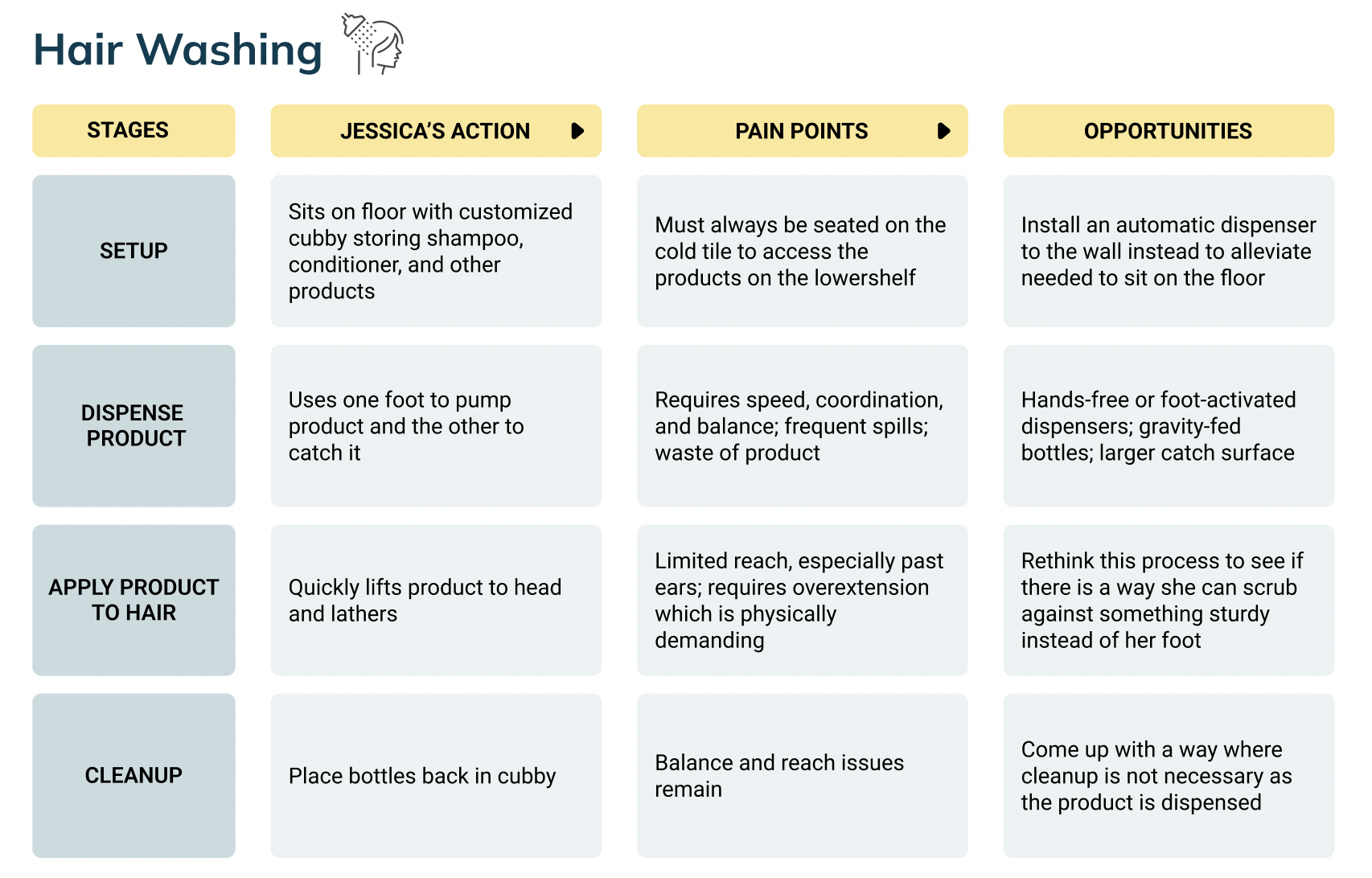
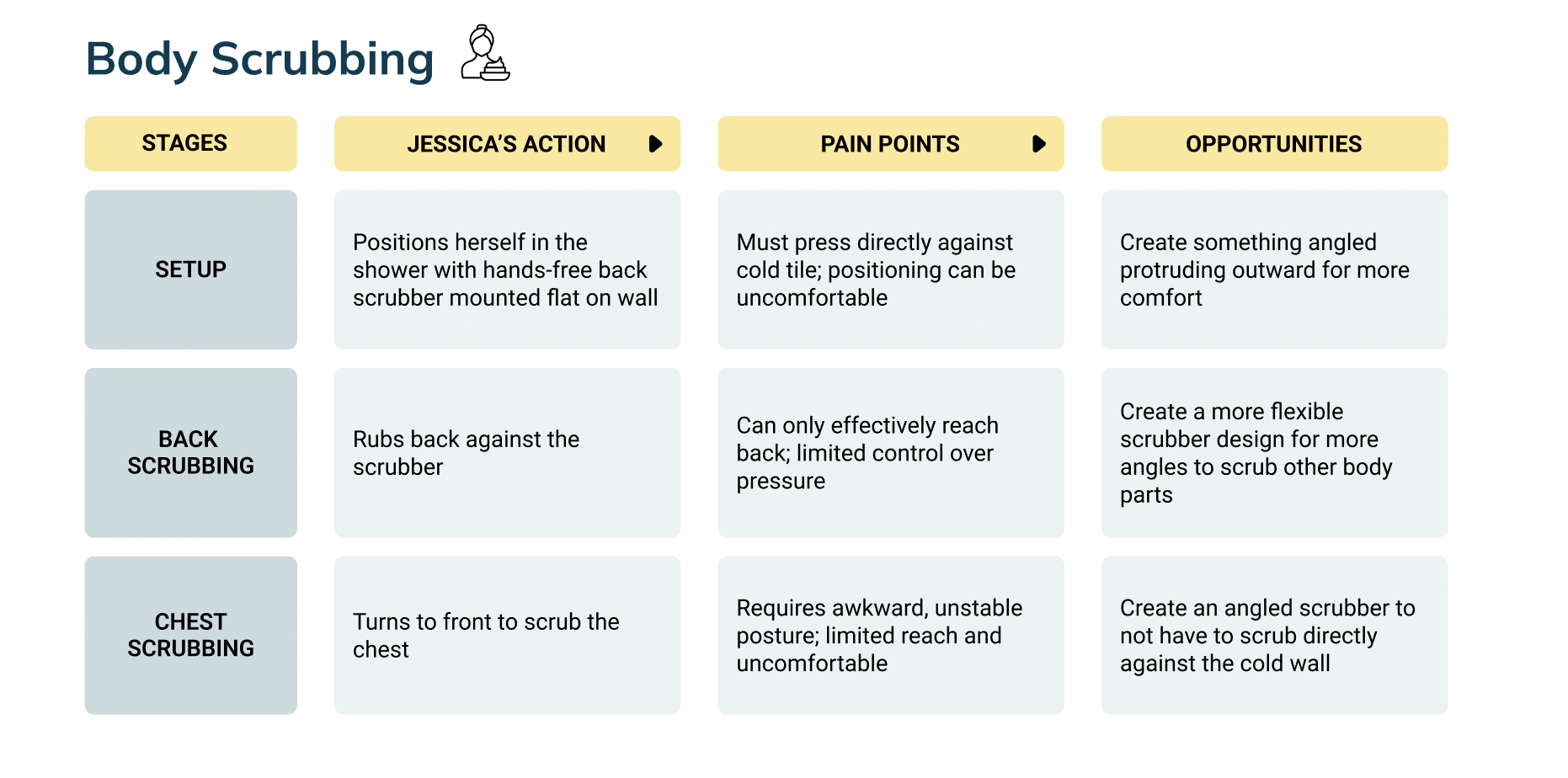
Observed current routines: hair washing, body scrubbing, and interaction with existing tools.
Discussed frustrations and inefficiencies with current setups.
Identified tasks that were difficult, time-consuming, or uncomfortable.
Explored goals and preferences, including independence, comfort, abilities, and minimizing product waste.
Ideated and prototyped custom solutions when existing products could not meet her needs.
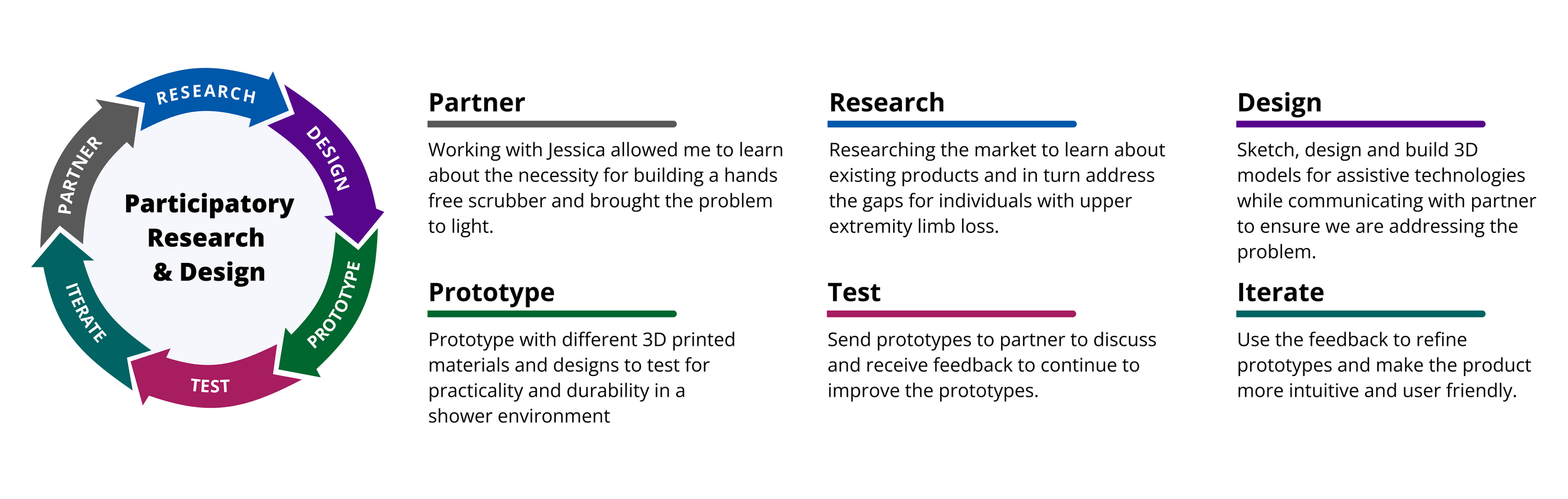
Jessica’s Journey Map
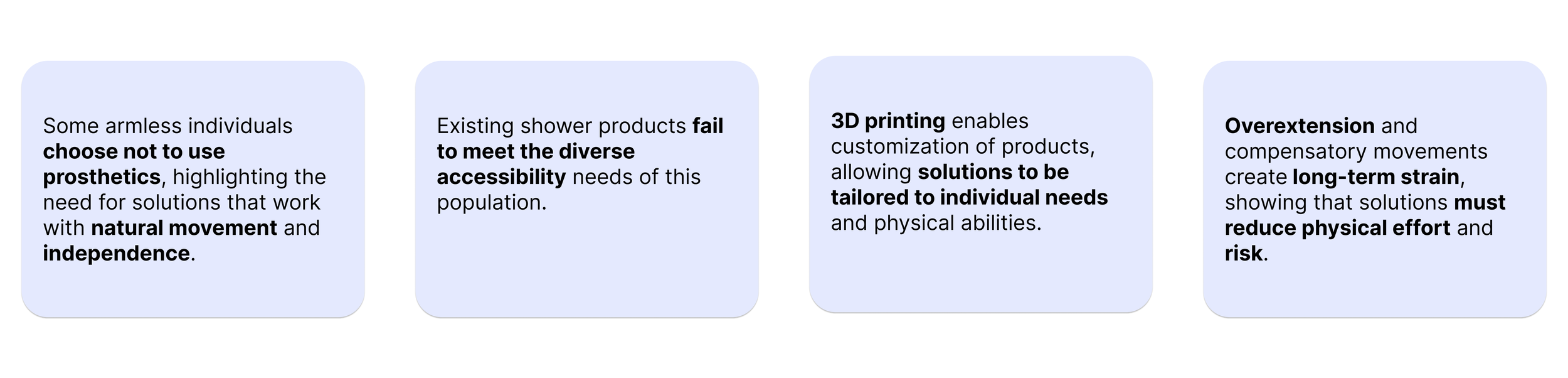
Additional Insights
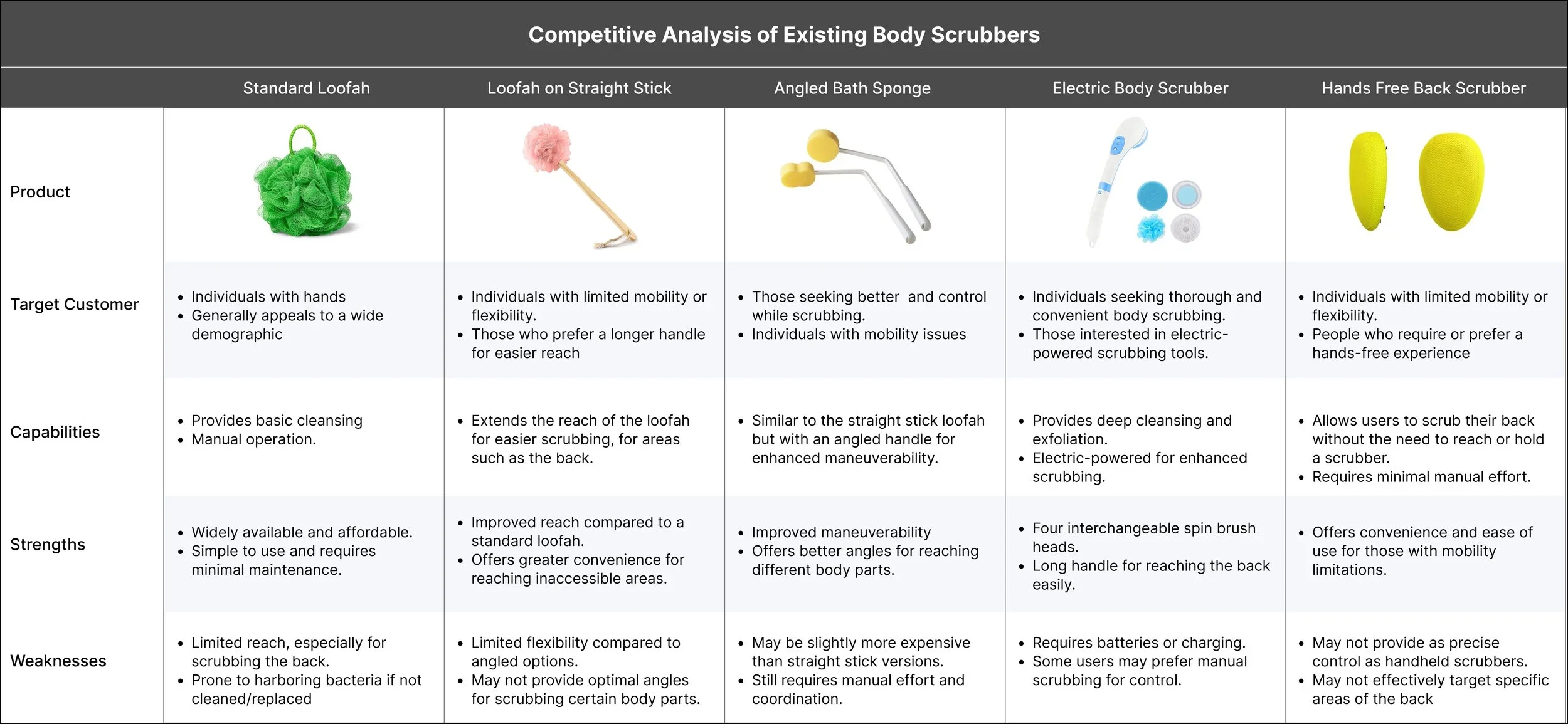
Competitive Analysis
I conducted a competitive analysis of existing body scrubbers to understand their limitations and identify opportunities for designing a more accessible, ergonomic, and user-centered solution for individuals with upper limb differences.
Phase 1 Prototypes Evolution
Materials
12-inch Shower Bar, Aluminum Clamp, Zip tie, Silicone body brush
Strengths
Angling the scrubber outward improved reach and coverage, making it easier to scrub different parts of the body.
Areas of Improvement
The silicone scrubber head was too small to cover a sufficient surface area, limiting efficiency.
It did not solve the overextension issue, as Jessica still had to reach to apply shampoo or body wash.
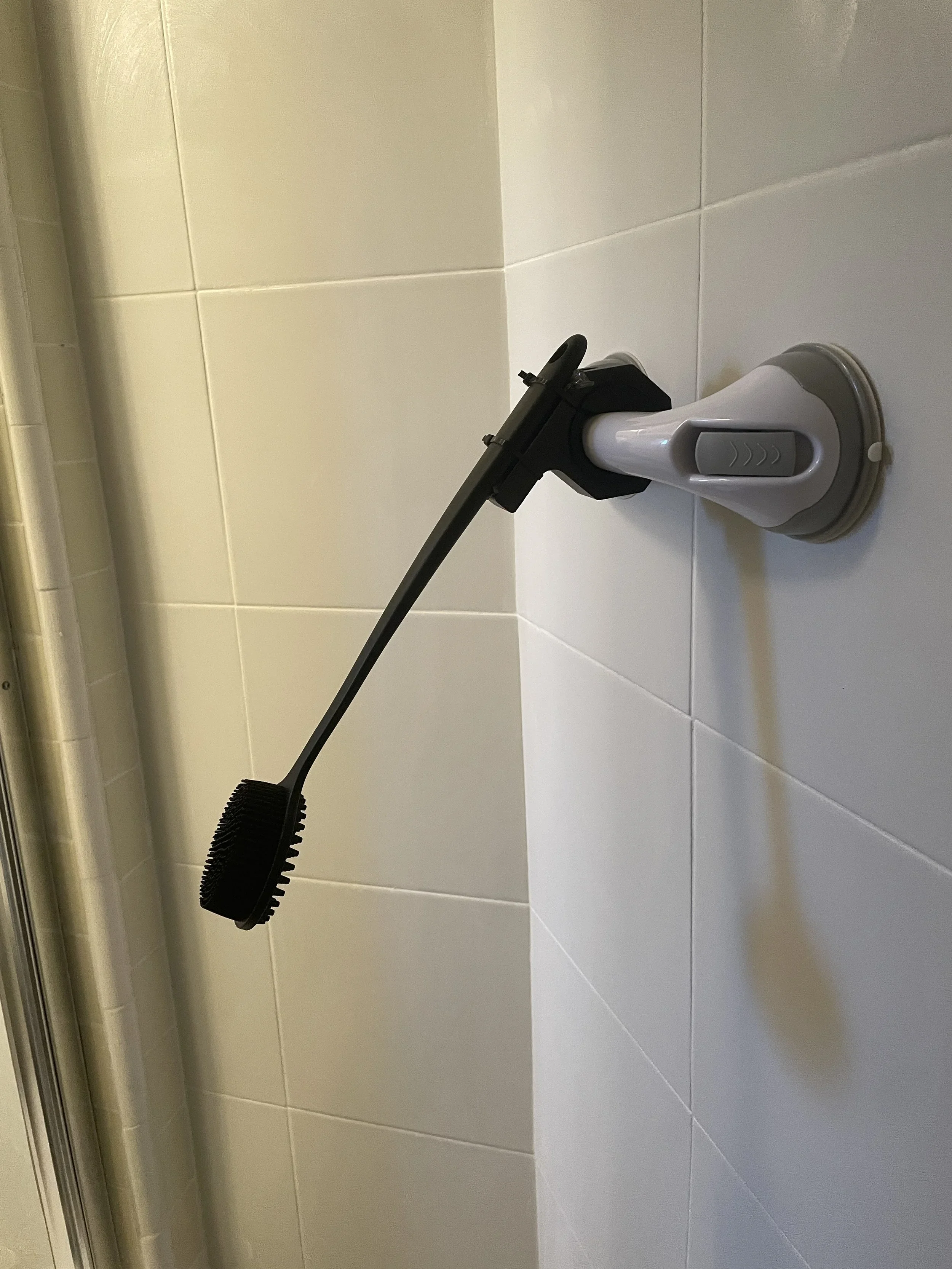
Prototype A - Proof of Concept
Prototype B - Proof of Concept
Materials
12-inch shower bar, adjustable bike clamp, zip tie, silicone body brush, braided loofah, automatic dispenser, tubing
Strengths
The motion-activated dispenser successfully delivered body wash through the loofah, and the rotating arm increased reach and flexibility.
Areas of Improvement
The arm could not be reliably locked in place, making the setup unstable during use.
3D Printed Materials
After testing these prototypes with existing products, I confirmed that the shower bar concept worked, though it needed to be longer for better reach. However, to truly address Jessica’s needs, I needed to move beyond off-the-shelf solutions, which led me to design and 3D-print custom components tailored to her body and showering routine. Structured layout to make it easy for humanitarian workers to understand purpose and access group-specific materials quickly.
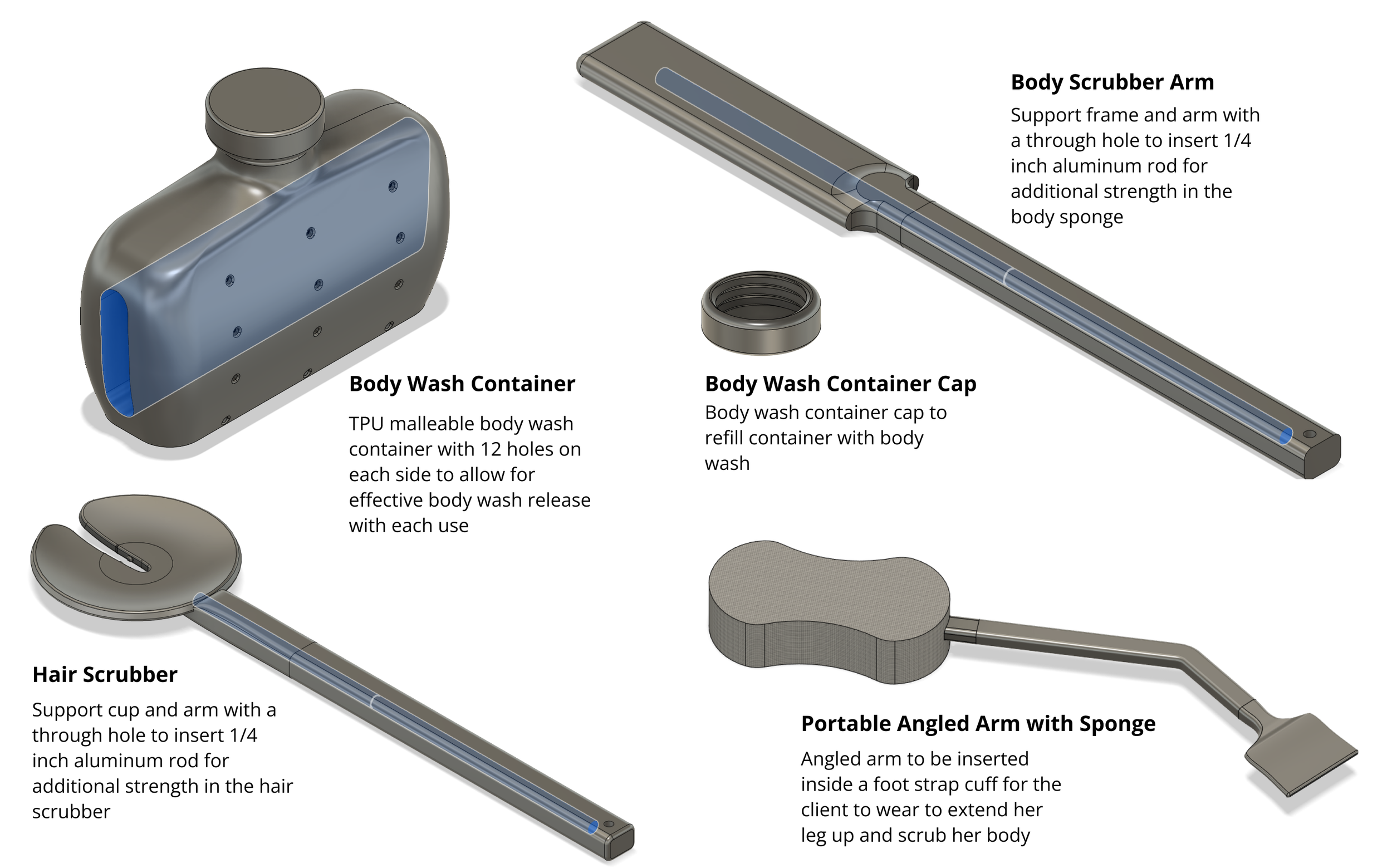
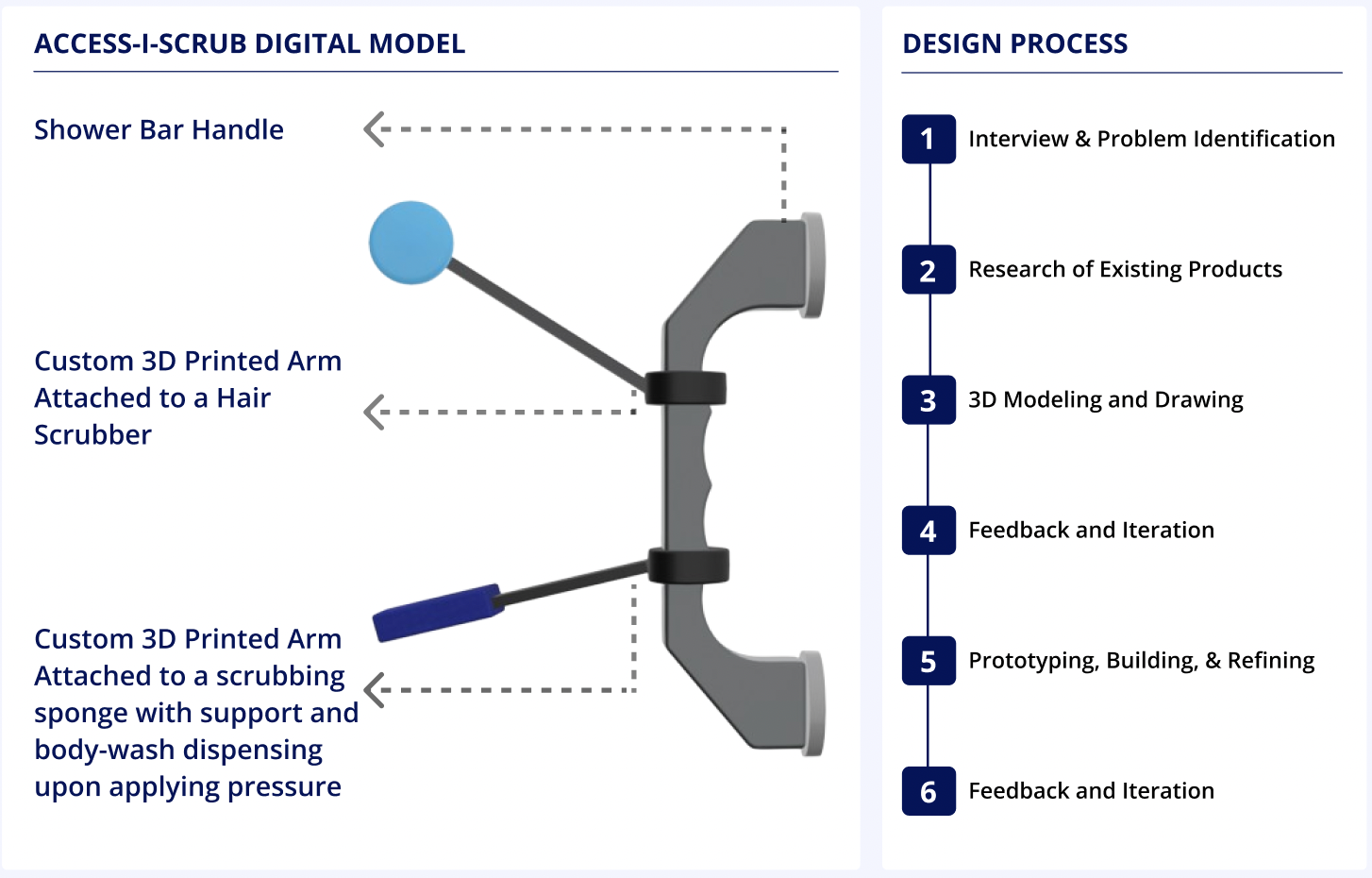
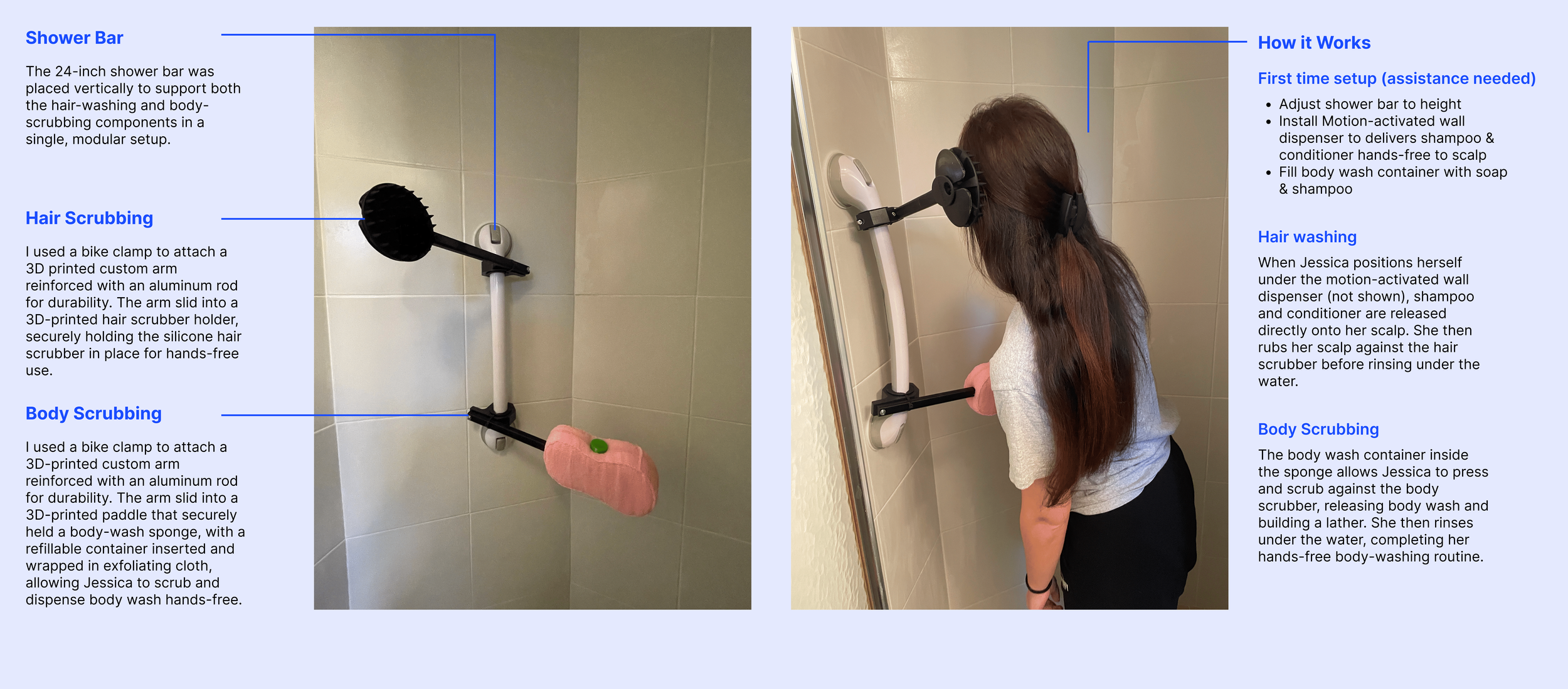
Final Prototype
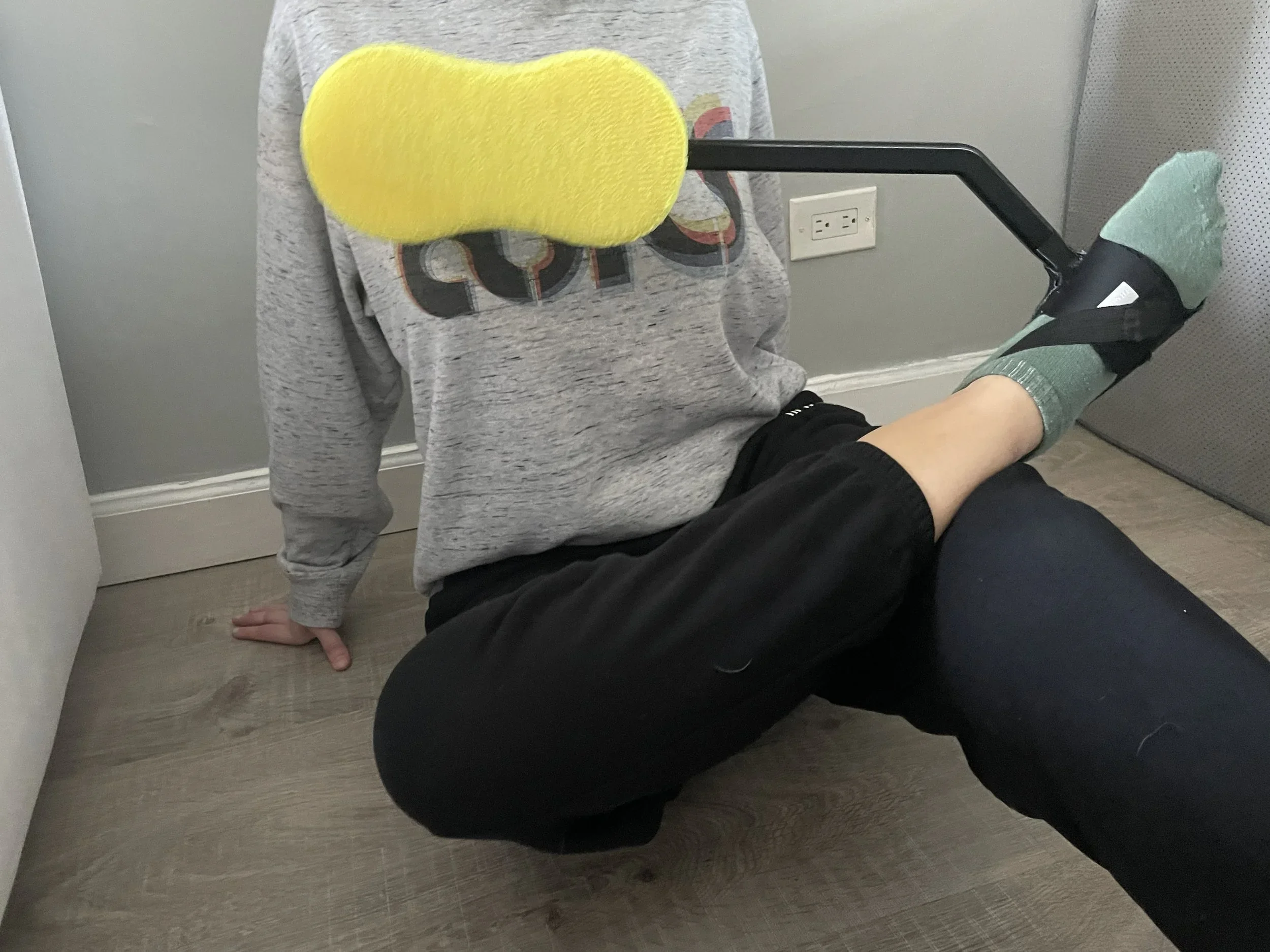
Portable Version
Another challenge Jessica highlighted was scrubbing her body while traveling, as she couldn’t access her home shower setup. Since she has good dexterity and can reach her head while seated, we designed a portable, foot-mounted scrubber.
Materials
Arthritis Foot Support Band, 3D PTEG Printed Support Band Insert and angled body scrubber arm, Sponge, Exfoliating Wash Cloth, Needle, and Thread.
Process
I adapted an adjustable arch support band, typically used for flat feet, to wrap around her ankle and foot. I modified the band by opening the internal cavity where the support gel sits.
For reach and coverage, I 3D-printed an angled body scrubber arm, allowing her to scrub her back and other hard-to-reach areas while seated.
A sponge wrapped with an exfoliating cloth completes the setup, giving her a compact, hands-free, on-the-go body-washing solution.
Jessica’s Feedback
Project Impact
This project delivered a custom, hands-free showering solution that enhanced Jessica’s independence, comfort, and efficiency in daily hygiene.
Key Outcomes
Improved independence: Enabled hands-free hair washing and body scrubbing at home and on the go.
Greater efficiency: Reduced wasted product and effort with a refillable body wash system and optimized scrubber placement.
Travel adaptability: Portable body scrubber allows effective hygiene outside the home.
Tailored solutions: Custom 3D-printed components addressed needs that off-the-shelf products could not.
This project was an incredible learning experience that deepened my understanding of designing for accessibility. I am deeply grateful to have worked alongside Jessica, whose insights shaped every decision.
Insights
Empathy and co-creation matter: Working directly with Jessica ensured the solutions truly met her needs.
Modular, adaptable design is essential for varied user contexts.
Ergonomics and reach drive usability: Small changes in angulation, height, and material make a large difference in comfort and effectiveness.
Observation and iteration guide innovation: Iterative prototyping and real-world testing uncovered pain points that research alone could not